
Why Consistent Evidence Matters More Than an Audit Score
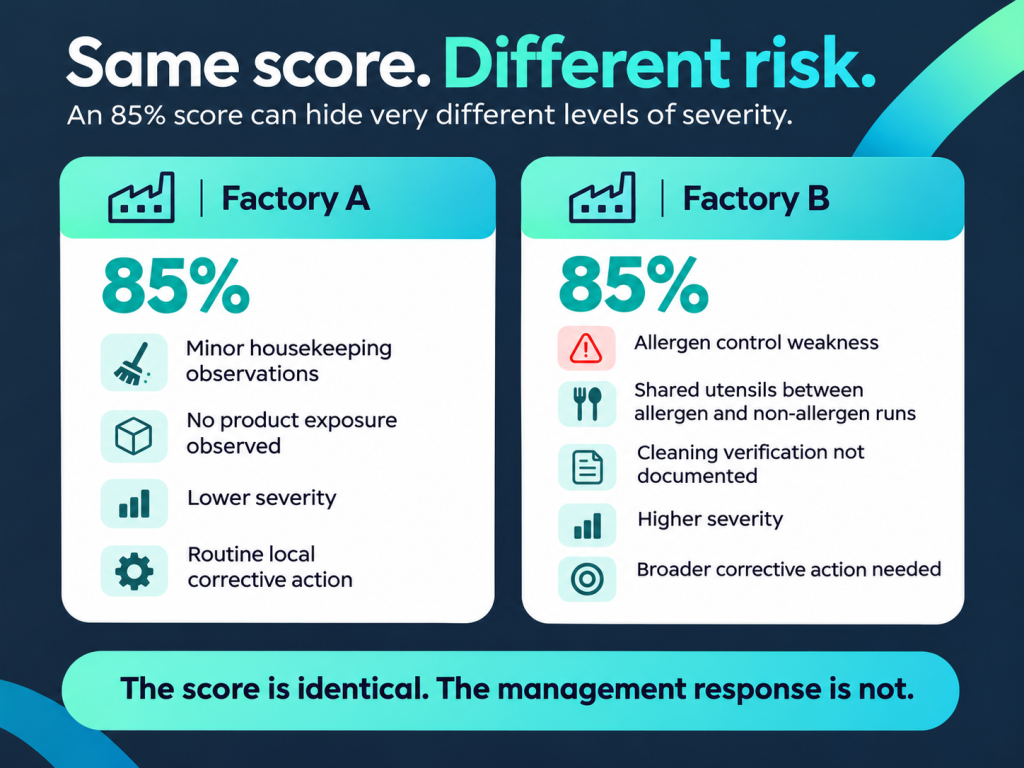
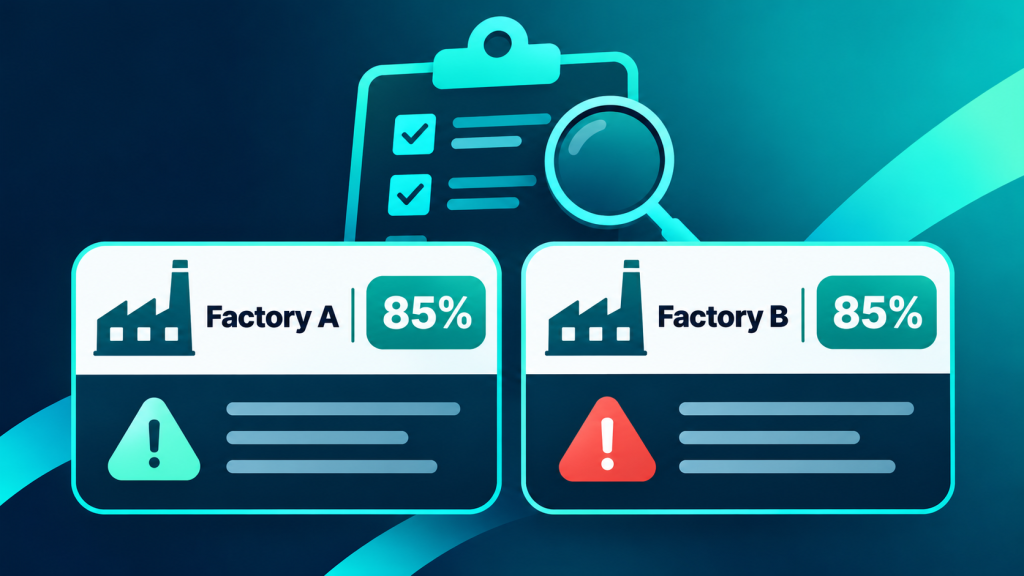
Two food factories each receive an audit score of 85%. From a distance, they appear to be performing at the same level.
But imagine one site has a collection of minor housekeeping observations, while the other has a serious weakness in allergen control and strong results everywhere else.
The scores are identical. The questions a Technical Manager needs to ask are not.
That’s the danger of allowing a single percentage to do a job it was never designed to do.
Scores are useful, up to a point that is.

Can we get the full picture?
A consistent scoring system can show changes over time, draw attention to outliers and help leadership see where it should ask more questions. There are good reasons why organisations use them.
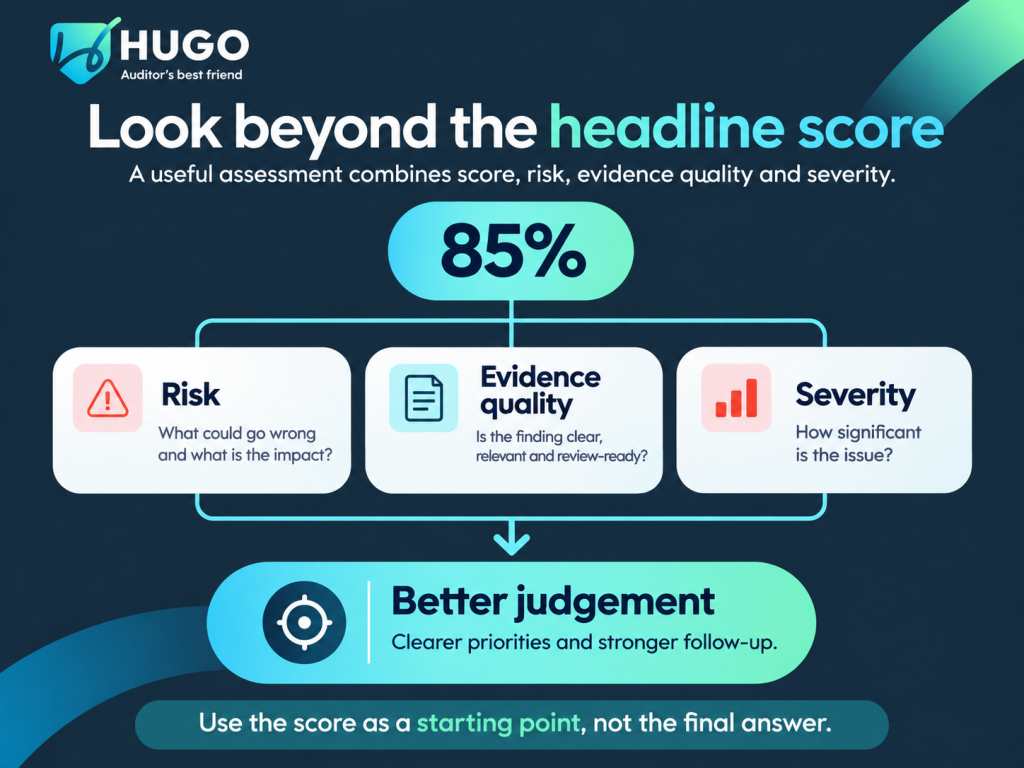
But a score is a summary of an assessment. It cannot tell the whole story about the severity of findings, the reliability of the evidence or the actions needed next.
This is particularly important in food manufacturing, where not all failures carry the same significance. A cosmetic issue and a weakness in a critical control should not be treated as though their practical consequences are interchangeable.
The right way to interpret a result depends on the audit standard and its specific scoring rules. Certification and regulatory requirements must be followed as written. The opportunity for improvement is in how organisations use internal audits and the intelligence underneath the numbers.
What makes evidence good?
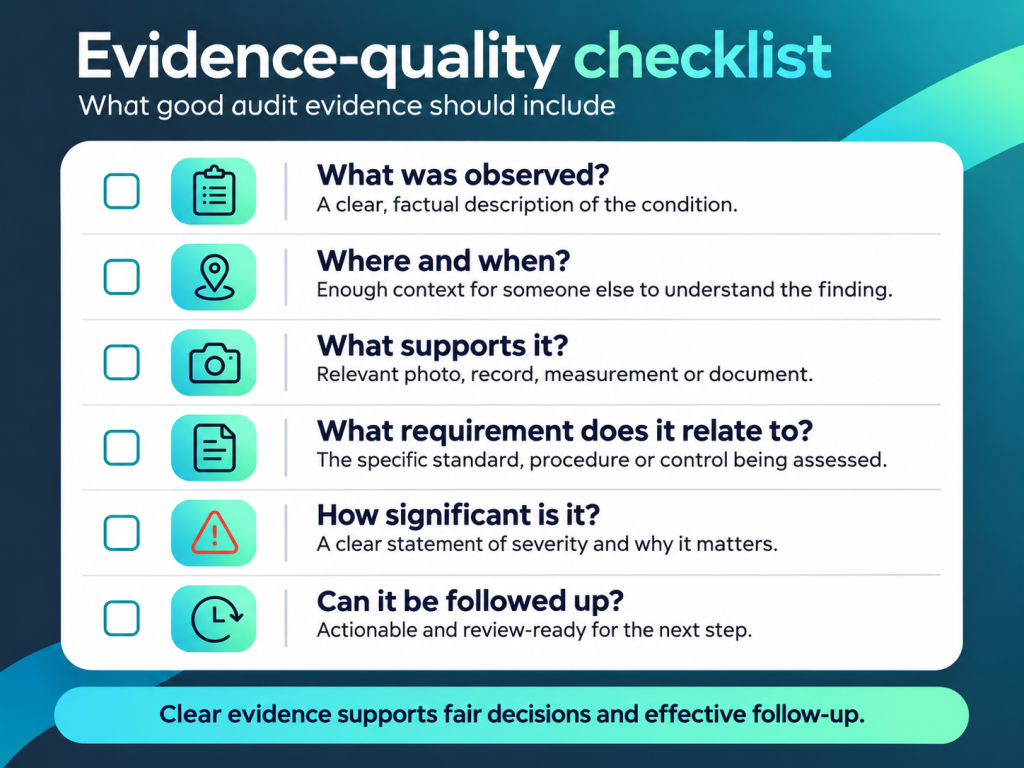
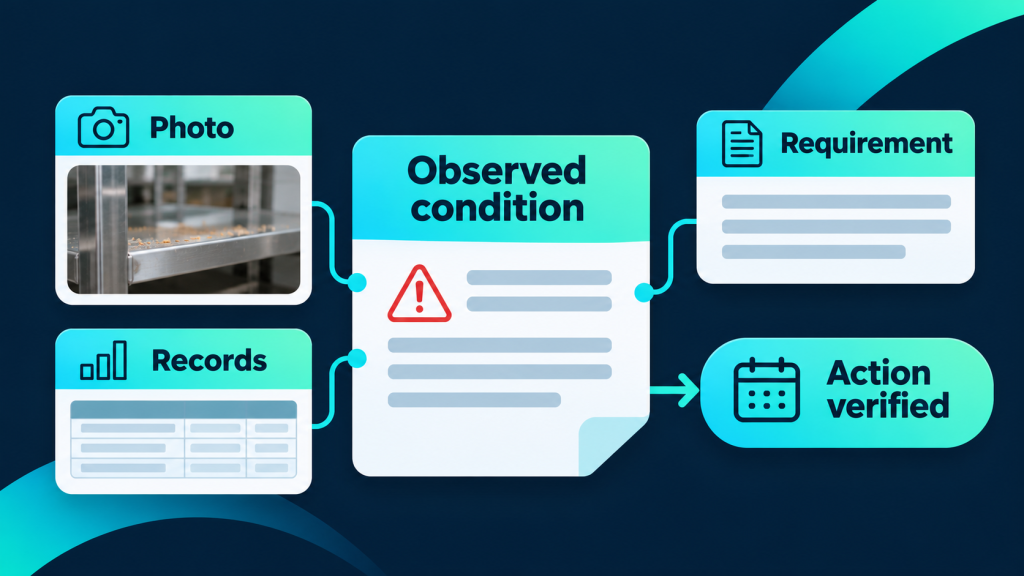
Evidence should establish what the auditor observed and why it supports the conclusion reached.
That sounds straightforward, but weak evidence creates problems later. An image with no context can be open to interpretation. A note saying ‘poor practice observed’ tells the site little about what needs to change. A checklist response with no supporting detail can be difficult to review or challenge.
Good evidence might include a clear description of the observed condition, a relevant photograph, records or measurements where appropriate, and the precise requirement being assessed. The amount and type needed should be proportionate to the finding.
It should allow somebody who wasn’t present to understand the decision.
That matters for the auditor, the site manager, the technical team and anybody reviewing the action later.
Consistency is not the elimination of judgement
We should be careful about the idea that good audit technology can remove professional judgement. It shouldn’t. Auditing depends on competent people making informed decisions in real environments.
However, competent auditors benefit from shared criteria. If two people assess the same situation, they should know what evidence is expected, how severity is determined and when a concern needs escalation.
That requires clear templates, examples, scoring guidance, calibration and quality review. The software can support those processes, but it cannot substitute for them.
A more consistent evidence base makes individual decisions easier to explain and results easier to compare.
Look beyond the headline percentage
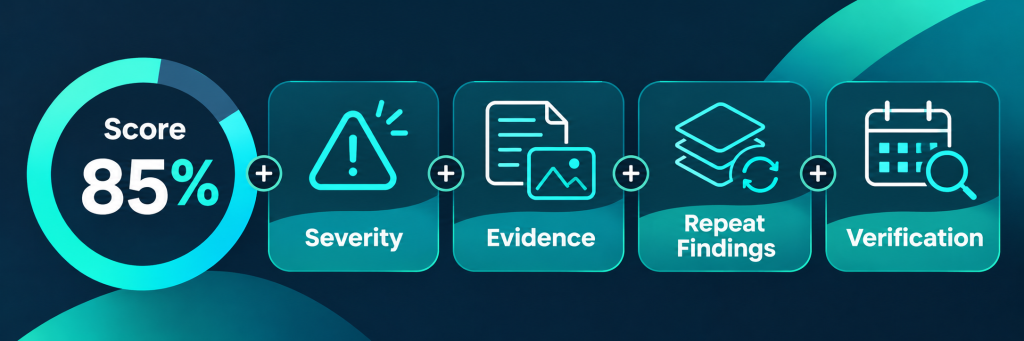
When reviewing audit results, I would ask five questions.
What are the highest-severity findings, regardless of the total score?
What evidence supports those findings and is it sufficiently clear?
Are similar weaknesses appearing across sites or repeated audit cycles?
Who owns the corrective actions and when should they be completed?
What evidence will demonstrate that the issue has been resolved?
Those questions lead towards operational control. A single percentage rarely does.
Compare, identify and correct
Imagine a group with several manufacturing sites. It can see an overall trend in audit scores and congratulate itself on modest improvement. But suppose the same allergen-control weakness is appearing in multiple locations. That shared pattern may be far more important than a movement of two percentage points in the average score.
With comparable findings and reliable supporting evidence, the technical leadership team can decide whether the response belongs at site level or whether something needs to change across the business.
Why context matters after the audit
Evidence also becomes more important when corrective actions are reviewed. An auditor identifies a concern and supplies observations. The site responds. Somebody needs to establish whether the response actually addresses the issue.
If the original evidence is missing or ambiguous, verification becomes harder. Teams may need to reconstruct what happened, request another visit or reopen a debate about what the finding meant.
Capturing reliable evidence at the point of observation is therefore about more than producing a better-looking report. It supports fair judgement and more effective follow-up.

Our approach at Hugo
We’re building Hugo to bring audit templates, findings, evidence and the actions that follow into a connected workflow. That doesn’t mean we’re claiming an algorithm can determine every audit decision. It means we want the people making those decisions to have better information and a clearer process.
The score can remain. It should simply become the beginning of a more useful conversation.
The question isn’t only ‘What did the factory score?’ It’s ‘What actually happened, how significant was it, and what are we doing about it?’
If you’re interested in an audit platform designed around that principle, join Hugo’s early-access list at https://www.hugoaudit.com.
Related stories

A food safety audit can generate a surprising amount of information. Temperature checks, hygiene observations, photographs, non-conformances and corrective actions. The difficulty often comes afterwards. A finding is written on a form, the report is emailed to the technical team, and the follow-up ends up in a spreadsheet that only a handful of people can access.

There is a curious habit in auditing. We measure the things that are easiest to count and then assume they tell us whether standards are improving. Audits completed. Reports issued. Average score. Percentage of the annual programme delivered.

In food manufacturing, there's very little room for error. Every product that leaves a factory has passed through a series of processes, people and checks designed to make sure it meets the right standards. From raw materials arriving on site to finished products leaving the warehouse, there are countless opportunities for something to go wrong.