
The Hidden Cost of Overdue Corrective Actions
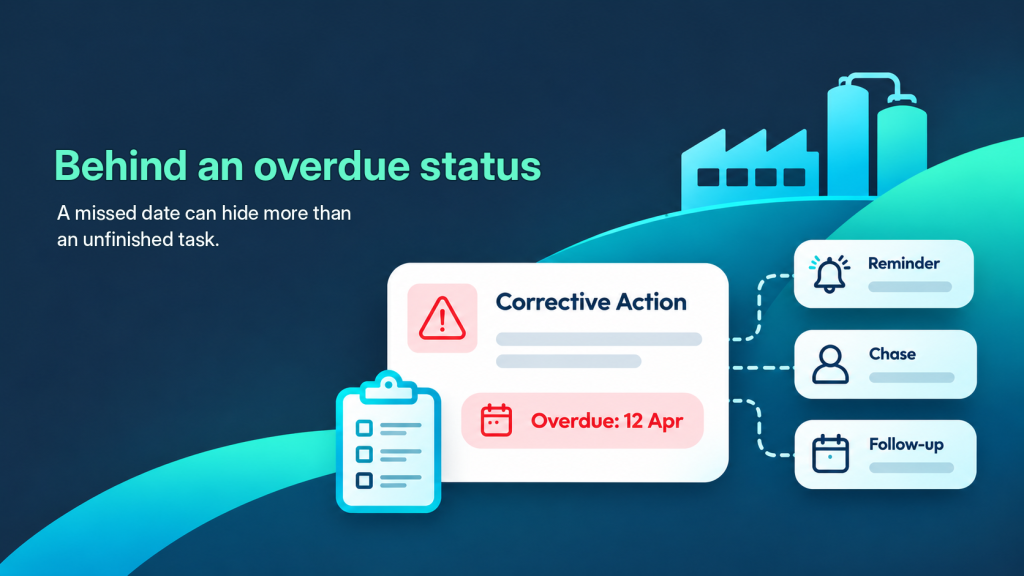
An overdue corrective action can look like an administrative problem. A red date on a tracker. Another reminder. A manager chasing a colleague for an update.
But the real cost can be much larger than the act of chasing. The original weakness may still exist. Time is being spent reconstructing information. And the organisation may have less confidence in whether the control is working.
We spend plenty of time discussing the cost of conducting audits. We should also talk about the cost of failing to act on what they find.

Where follow-up starts to unravel
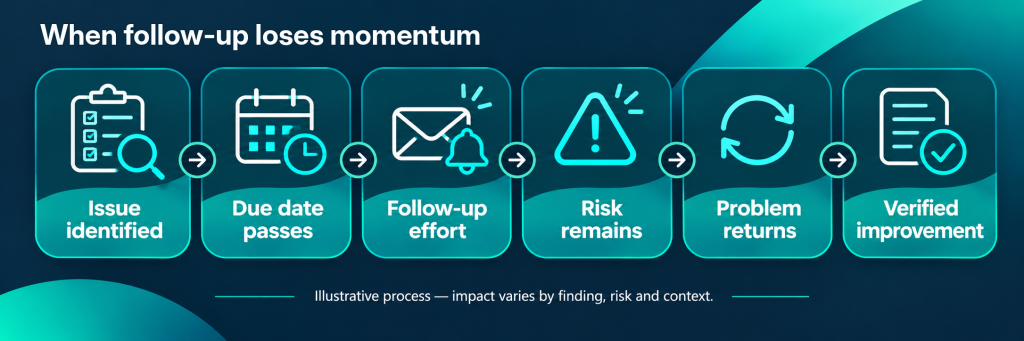
Think about a routine audit that identifies several issues. The auditor records the findings and distributes the report. Each action needs an owner, an appropriate response, a due date and an effective way to demonstrate completion.
In an ideal process, that chain is clear. In reality, it can involve multiple teams, email inboxes, spreadsheets and external auditors. An action gets reassigned. Someone goes on leave. Evidence is submitted in the wrong format. The status is updated but nobody is certain whether the problem was really solved.
By the time the next audit takes place, a significant amount of management energy may have been consumed with administration instead of improvement.
Four types of cost
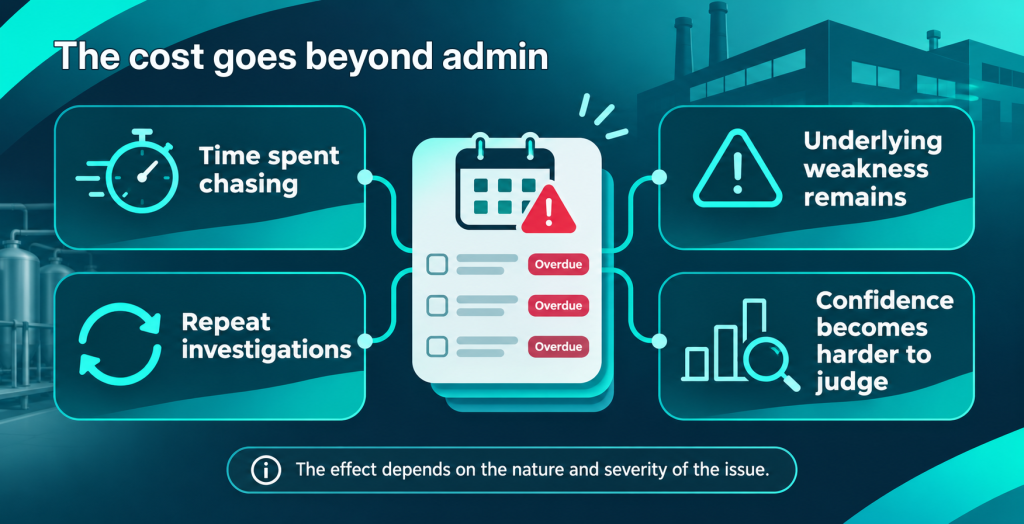
The first is management time. Chasing, clarifying, reviewing and escalating take time from technical managers, site teams and auditors.
The second is operational exposure. Where a finding relates to a meaningful safety or quality risk, delay may prolong the underlying weakness. The consequence depends on the nature and severity of the issue; it should never be exaggerated for marketing purposes.
The third is the cost of repetition. If an issue is not effectively resolved, it may appear again, leading to another investigation, action plan and review.
The fourth is confidence. Leaders need to know whether actions have genuinely improved controls. If the evidence is scattered or inconsistent, they may struggle to make that judgement.
An illustrative calculation
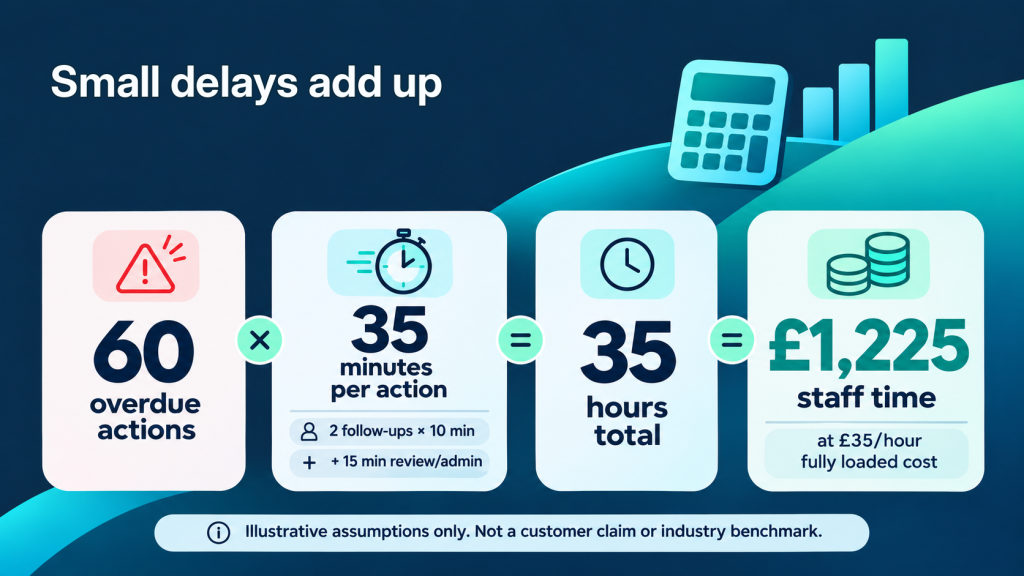
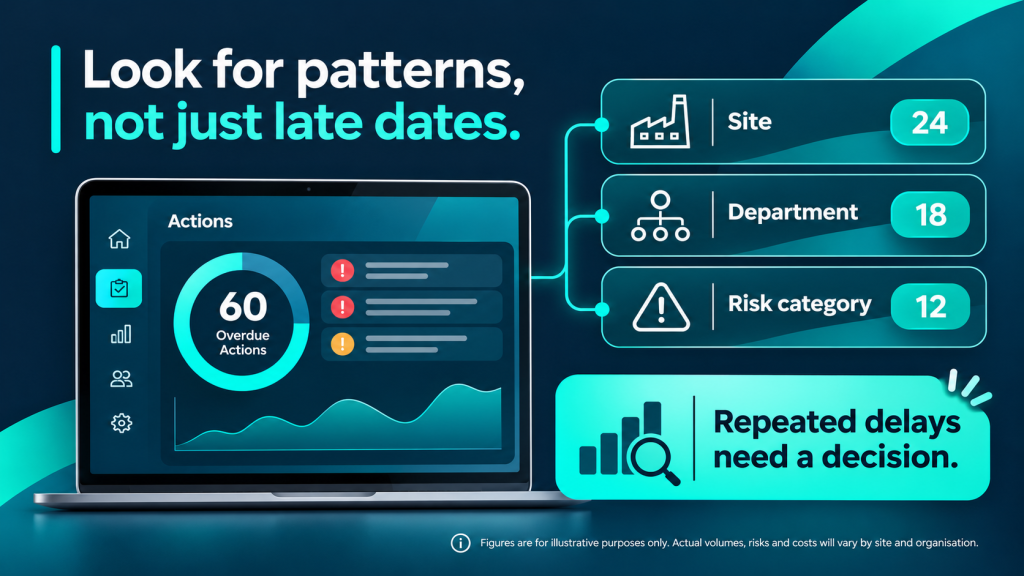
Consider a hypothetical multi-site manufacturer with 60 overdue actions across its internal audit programme. Suppose each action requires, on average, two follow-up exchanges taking 10 minutes each, plus 15 minutes of review and administration.
That is 35 minutes per action, or 35 hours across the backlog.
If we use an illustrative fully loaded management cost of £35 per hour, those activities represent £1,225 of staff time. This is not a claim about a Hugo customer or an estimate of typical industry performance. The assumptions are deliberately simple, and real circumstances vary enormously.
The point is not the precise number. It’s that the cost of fragmentation is easy to overlook because it appears as small pieces of time spread across many people’s working days.
And the calculation says nothing about the potential consequences of an unresolved high-risk finding.
Ownership must be unmistakable
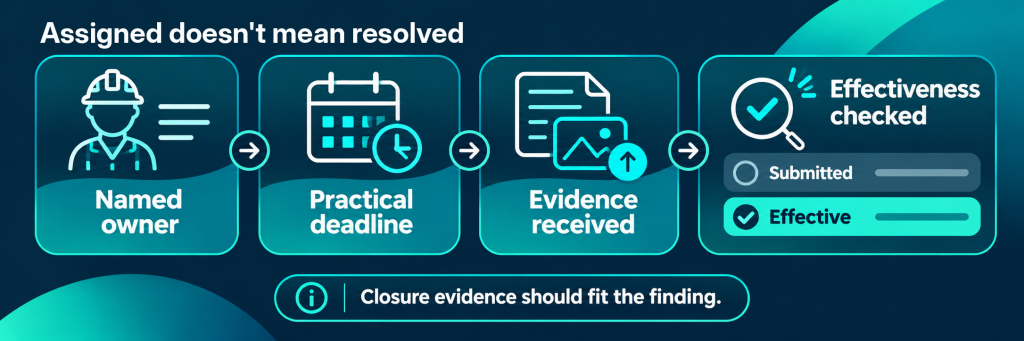
A corrective action should identify who is responsible for delivering the response, what they need to do and by when. For more complex issues, there may be separate responsibilities for implementation and verification.
If an action is assigned vaguely to ‘operations’ or ‘the site’, follow-up becomes harder. If deadlines don’t reflect risk and practical delivery, people learn to ignore them. If escalation is inconsistent, a backlog becomes normal.
Clear ownership isn’t bureaucracy. It’s the foundation of accountability.
Evidence of closure isn’t always evidence of effectiveness
There is another trap: confusing completion with proof.
A revised procedure may address a documentation gap, but not necessarily a behavioural problem. A photograph may show that one issue has been corrected, but not that the wider process now works consistently.
The method of verification must fit the finding. Sometimes a documentary check is proportionate. Sometimes observation, sampling, testing or a further site visit may be appropriate.
Good follow-up makes that distinction explicit rather than treating every ‘closed’ status as equally reassuring.
Patterns matter more than isolated deadlines
A single late action may have an understandable explanation. Repeated overdue actions in the same location, department or risk category tell a different story. They might indicate unrealistic action plans, a lack of resource or unclear accountability.
Management needs a way to see those patterns early. Otherwise it receives periodic lists of overdue items without understanding what support or intervention is required.
That’s where an audit process starts to become management intelligence: not simply identifying a backlog, but using it to ask better questions.

What we're building
Hugo is being designed around a connected audit lifecycle, so findings, evidence, action ownership and follow-up don’t disappear into separate documents. The goal is to help auditors, site teams and leaders see the same story and act on it.
That isn’t a claim that technology alone fixes poor management. It cannot. But the right workflow can make ambiguity harder to ignore and progress easier to verify.
A finding without ownership is a problem waiting to be rediscovered.
One practical improvement is to review the backlog at a fixed cadence, with clear escalation for significant findings. The meeting should not simply read out every overdue action. It should identify blockers, agree who will remove them and test whether the proposed closure evidence is suitable. This gives the team a way to turn a static list into a sequence of decisions.
If you want to see how Hugo is approaching audit follow-up, join our early-access list at https://www.hugoaudit.com.
Related stories

A food safety audit can generate a surprising amount of information. Temperature checks, hygiene observations, photographs, non-conformances and corrective actions. The difficulty often comes afterwards. A finding is written on a form, the report is emailed to the technical team, and the follow-up ends up in a spreadsheet that only a handful of people can access.

There is a curious habit in auditing. We measure the things that are easiest to count and then assume they tell us whether standards are improving. Audits completed. Reports issued. Average score. Percentage of the annual programme delivered.

In food manufacturing, there's very little room for error. Every product that leaves a factory has passed through a series of processes, people and checks designed to make sure it meets the right standards. From raw materials arriving on site to finished products leaving the warehouse, there are countless opportunities for something to go wrong.