
How SaaS Is Changing the Way We Manage Food Safety and Audits
A food safety audit can generate a surprising amount of information. Temperature checks, hygiene observations, photographs, non-conformances and corrective actions.
The difficulty often comes afterwards. A finding is written on a form, the report is emailed to the technical team, and the follow-up ends up in a spreadsheet that only a handful of people can access. By the time someone asks for an update, the information is scattered across three places.
It’s a familiar problem, and one reason software-as-a-service (SaaS) is becoming an increasingly useful part of food safety management.
Not because technology can replace an experienced auditor, but because it can make their work easier to act on.

When the paperwork becomes the workload
Food safety teams have no shortage of responsibilities. Internal audits, GMP inspections, supplier checks, customer requirements and daily production pressures all compete for attention.
Many businesses have already moved away from paper checklists, which is progress. But swapping a clipboard for a digital form doesn’t necessarily fix the bigger problem. If findings still have to be copied into a report, sent by email and manually chased, the process remains fragmented.
Consider a damaged chiller seal found during a routine inspection. The auditor records it, maintenance is informed and the immediate issue is dealt with. Weeks later, a similar finding appears on another line.
Was it an isolated incident or evidence of a wider maintenance problem?
Answering that shouldn’t require digging through old files.
What exactly does SaaS change?
Put simply, SaaS is software accessed as an ongoing service, usually through a browser or app, rather than a system installed and managed separately on each computer.
For food auditing, its value lies less in where the software lives and more in how work moves through it.
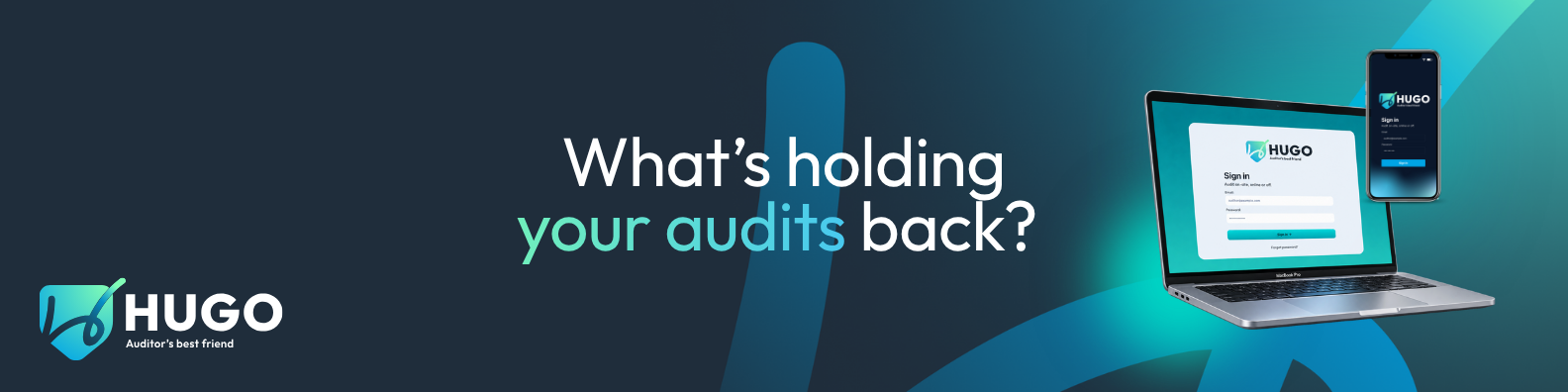
Audit templates, completed inspections, supporting evidence and follow-up actions can sit within a shared process instead of being spread across different tools.
That means a QA manager can spend less time pulling together updates and more time understanding which issues need attention.
Good software should reduce the distance between identifying a problem and doing something about it.
Better visibility, not just better record-keeping
Accurate records remain essential. The Food Standards Agency’s HACCP guidance makes clear that businesses need documentation showing controls are in place, monitored and maintained, including records of deviations and corrective actions.
SaaS can help keep that evidence organised and easier to retrieve. But its real potential is in making it useful between audits.
A recurring hygiene issue may look minor in one report. Seen alongside findings from several shifts or sites, it may point towards a training gap, an unsuitable cleaning method or equipment that needs attention.
Having information in one place makes patterns easier to recognise.
It also helps managers ask better questions. Which actions are overdue? Are the same non-conformances appearing again? Are improvements holding up over time?
It’s about turning information into something people can actually use.
The reality of the factory floor
Any food safety platform has to work in the conditions where audits actually happen.
Production areas are noisy and busy. Auditors move between lines, cold stores, warehouses and preparation spaces. They need to record findings quickly, attach evidence and carry on without disrupting the inspection. Connectivity can also be unreliable in some parts of a site.
This is why an online-only approach won’t suit every environment. Offline capability matters when an auditor needs to continue working without a dependable connection.
Just as important is usability.
If recording a straightforward observation takes too many steps, people will find ways around the system. Technology is only helpful when it fits the work, rather than forcing the work to fit the technology.
Software isn't a substitute for good judgement
There’s a temptation to assume that going digital automatically makes a business safer. It doesn’t.
A completed electronic checklist can be just as superficial as a paper one.
Someone still needs to recognise a risk, ask the right questions, investigate the cause of a failure and verify that the corrective action worked.
The best SaaS platforms support those decisions. They don’t pretend to make them on behalf of the technical team.
Before introducing a new system, businesses should look beyond the feature list.
Can the people conducting audits use it comfortably? Does it make responsibilities clear? Can evidence be found when needed? Will it help identify repeat problems rather than simply produce more reports?
Those answers matter far more than an impressive dashboard on its own.
Where Hugo comes in
Hugo is being built around a simple idea, an audit should lead somewhere.
Designed with the needs of food and drink manufacturers, quality assurance teams and auditing professionals in mind, Hugo brings the practical stages of auditing into a connected SaaS platform.
The aim is to make it easier to create and carry out audits, record findings and evidence, and manage the actions that follow.
Hugo also supports auditing online and offline, recognising that real inspections don’t always happen somewhere with a reliable signal.
Its approach to AI-assisted audit creation is another way of reducing preparation time. Existing audit documents can be used to help build editable forms, which teams can review and tailor before use.
Rather than treating a completed report as the finish line, Hugo is being developed to help teams keep sight of what happens next, from outstanding actions to wider audit performance.
A smarter way to move forward.
Food safety will always depend on knowledgeable people, sound processes and consistent follow-through.
SaaS can’t replace any of those things. What it can do is remove some of the friction that gets in their way.
Ready to explore a more connected approach to auditing?
Hugo is currently welcoming early interest from food and drink manufacturers, quality teams, auditors and businesses looking to improve the way they manage audits.
Join the Hugo early access waitlist at www.hugoaudit.com and be among the first to discover what’s coming.
Hugo. Beyond the Audit.
Related stories

Join waitlist The Hidden Cost of Overdue Corrective Actions An overdue corrective action can look like an administrative problem. A red date on a tracker. Another reminder. A manager chasing a colleague for an update. But the real cost can be much larger than the act of chasing. The original weakness may still exist. Time […]
Join waitlist The Hidden Cost of Overdue Corrective Actions An overdue corrective action can look like an administrative problem. A red date on a tracker. Another reminder. …
Join waitlist The Hidden Cost of Overdue Corrective Actions An overdue corrective action can look like an administrative problem. A red date on a tracker. Another reminder. A manager chasing …